Skip to content Skip to navigation

East Georgia State College Campus Plan Update 2025

East Georgia State College (EGSC) is an associate degree granting, liberal arts institution providing access to academically transferable programs of study and targeted baccalaureate degrees at low cost to its students. As a unit of the University System of Georgia (USG) within the State College Sector, EGSC extends its access mission from its home campus in Swainsboro to instructional sites on the campuses of Georgia Southern University in Statesboro and Augusta University in Augusta.

At its April 2025, the USG Board of Regents approved Chancellor Sonny Perdue’s recommendation that East Georgia State College and Georgia Southern University be consolidated. A substantive change prospectus detailing the consolidation was submitted to the Southern Association of Colleges and Schools (SACSCOC). The prospectus is scheduled to be reviewed and voted on by the SASCOC Board of Trustees at the SACSCOC 2025 annual meeting in December. Both USG institutions are accredited by SACSCOC. Upon approval of the consolidation by the SASCOC Board of Trustees, the consolidation will take effect on January 1, 2026. Following a successful on-site peer review in April 2026, the SASCOC Board of Trustees and the USG Board of Regents will take final actions to complete the consolidation process.

Because of the consolidation process, East Georgia’s presence on the Augusta University campus will end at the conclusion of Spring Semester 2026. A teach-out plan for EGSC Augusta has been approved by SACSCOC.

Presented in Tables 1a and 1b below are the number and percentages of EGSC fall semester students broken down by location and mode of delivery for Fall 2016 through Fall 2025. The declines in fall-to-fall enrollment experienced in recent years have been reversed by a 3.3 percent enrollment increase in Fall Semester 2024 and a 7.7 percent increase for Fall Semester 2025.

Table 1a: Enrollment by Location/Delivery Mode: Fall Semesters 2016-2025

Fall Semester

2016

2017

2018

2019

2020

2021

2022

2023

2024

2025

High School

115

101

96

33

76

100

151

191

208

182

Online Only

260

383

443

493

797

680

558

490

509

732

Augusta

462

429

386

357

246

236

193

191

175

181

Statesboro

1,249

1,078

1,075

973

634

425

413

370

361

340

Swainsboro

1,066

1,012

942

885

662

582

585

526

573

531

Total Enrolled

3,152

3,003

2,942

2,741

2,415

2,023

1,900

1,768

1,826

1,966

Table 1b: Percentage of Enrollment by Location/Delivery Mode: Fall Semesters 2016-2025

Fall Semester

2016

2017

2018

2019

2020

2021

2022

2023

2024

2025

High School

3.6%

3.4%

3.3%

1.2%

3.1%

4.9%

7.9%

10.8%

11.4%

9.3%

Online Only

8.2%

12.8%

15.1%

18.0%

33.0%

33.6%

29.4%

27.7%

27.9%

37.2%

Augusta

14.7%

14.3%

13.1%

13.0%

10.2%

11.7%

10.2%

10.8%

9.6%

9.2%

Statesboro

39.6%

35.9%

36.5%

35.5%

26.3%

21.0%

21.7%

20.9%

19.8%

17.3%

Swainsboro

33.8%

33.7%

32.0%

32.3%

27.4%

28.8%

30.8%

29.8%

31.4%

27.0%

EGSC Academic Program Review

Prior to the consolidation EGSC offered the five associate degrees and one bachelor degree listed below:

  • Associate of Arts in Elementary Education
  • Associate of Arts in Liberal Arts (formally Associate of Arts, Core Curriculum)
  • Associate of Arts in Social Sciences (introduced in Fall Semester 2021)
  • Associate of Science in Business Administration
  • Associate of Science in Natural Sciences (introduced in Fall Semester 2021)
  • Bachelor of Business Administration (introduced in Spring 2025)

In addition, EGSC was approved to offer its students the following eMajor degrees in cooperation with USG eCampus:

  • Associate of Science in Financial Technology (begun in Spring Semester 2023)
  • Bachelor of Science in Criminal Justice (begun in Fall Semester 2023)      
  • Bachelor of Science Degree in Organizational Leadership (beginning in Spring Semester 2024)

As part of the consolidation, EGSC’s three associate degrees and one bachelor degree with disciplinary distinction will be terminated. The Bachelor of Science in Organizational Leadership is the only eCampus degree that will be retained by the consolidated Georgia Southern University.

Fall Semester 2025 Student Profile

Throughout the Complete College Georgia initiative (2012 to 2025), EGSC’s four largest demographic cohorts have been African American (Black) Females; African American (Black) Males; White (Non-Hispanic) Females; and White (Non-Hispanic) Males. As indicated in Table 2 below for Fall Semester 2025, EGSC serves higher proportions of Black students and lower proportions of Asian and Hispanic students compared to the USG State College Sector.

Table 2: EGSC/State College Sector Fall 2025 Ethnic Comparisons 

Ethnic Comparisons

EGSC

State College Sector

Count

Percent

Count

Percent

Asian

35

1.8%

2,059

5.0%

Black

857

43.6%

10,829

26.5%

Hispanic

165

8.4%

8,612

21.1%

Multiracial

95

4.8%

1,366

3.3%

White

781

39.7%

16,931

41.5%

Other

33

1.7%

1,010

2.5%

Fall Semester 2025 First-Time Freshmen (FTF) Profile

Presented in Table 3 below is a breakdown by percentage of first-time freshmen (FTF) based on course load for Fall Semester 2025. Most first-time freshmen who attend one or more classes at an EGSC location are full-time. In contrast, a smaller majority of FTF taking classes online only are full-time students.

Table 3: Fall 2025 First-Time Freshmen by Course Load

FTF Fall 2025 Course Load

Augusta

Statesboro

Swainsboro

Online Only

Overall

Full-Time Percentage

79.8%

87.6%

92.6%

61.1%

82.6%

Part-Time Percentage

20.2%

12.4%

7.4%

38.9%

17.4%

Presented in Table 4 below is a breakdown by percentage of Fall 2025 first-time freshmen are first generation college students and who receive a Pell Grant.

Table 4: Fall 2025 First-Time Freshmen First Generation and Pell Grant Recipients

FTF Fall 2025 First Generation /Pell Recipient

Augusta

Statesboro

Swainsboro

Online Only

Overall

First Generation Percentage

4.8%

6.5%

6.2%

7.6%

6.4%

Pell Grant Recipient Percentage

63.5%

62.9%

72.4%

72.2%

68.4%

EGSC Comparisons with Peer Colleges

The following analysis is based on the IPEDS Data Feedback Report 2024 for East Georgia State College.

In 2017, EGSC selected fifteen colleges, including three within the USG, as its comparison group for the National Center for Education Statistics (NCES). Each EGSC data feedback report generated from the Integrated Postsecondary Education Data System (IPEDS) compares the College to this group. According to the IPEDS Data Feedback Report 2024 for the College, 40 percent of EGSC enrolled students in Fall Semester 2023 were Black, in contrast with 7 percent for its comparison group. In addition, 43 percent of EGSC enrolled students in Fall Semester 2023 were white, in contrast with 58 percent for its comparison group. In Fall Semester 2023, EGSC 42 percent of its students did not take any distance education courses, in contrast to 30 percent of its comparators. As in previous years, tuition and fees charged by EGSC to full-time, first-time (FTFT) students were lower than its comparison group. In contrast, the average net price of attendance for FTFT students was slightly higher at EGSC than for its comparison group.

The 2024 feedback report included three-year associate degree graduation and transfer-out rates for the Fall Semester 2017 FTFT cohort. While EGSC’s graduation rate of 14 percent was lower than the 34 percent average for its comparison group, EGSC’s transfer-out rate of 54 percent was substantially higher than the 15 percent average for its comparison group. The combination of these two rates for the Fall 2017 FTFT cohort indicates a success rate of 68 percent for EGSC in fulfilling its access mission.

Success Inventory

Student Orientation Course Update (East Georgia State College-2025)

Strategy/Project Name: 
Student Orientation Course Update
Momentum Area: 
Purpose
Strategy/Project Description: 

As part of the consolidation with Georgia Southern University (GS), an EGSC/GS team is proposing to replace EGSC’s 1 credit hour CATS 1101 Critical and Academic Thinking for Success freshmen orientation course with two 1 credit hour courses, as presented below along with their draft student learning outcomes (SLOs):

  1. FLYT Flight 1001: Foundations for Academic & Career Exploration SLO: Students will explore academic majors and career options by examining their personal interests, strengths, and values, and by identifying campus resources and degree pathways that support informed choices and long-term planning.
  2. FLYT Flight 1002: From Exploration to Action SLO: Students will create a personalized academic and career plan by integrating their interests, strengths, and values with institutional resources, degree pathways, and high-impact opportunities such as research, service learning, internships, and/or study abroad.

The first course will be in the Institutional Priority section of Core IMPACTS and the second course will be in the Additional Requirement section. Students completing either a four or two-year degree will be required to take both courses to fulfill their degree requirements.

Activity Status: 
Evaluation/Assessment plan: 

The SLOs of each course will be assessed based on career exploration artifacts and academic and career plans.

Progress and Adjustments: 

Progress will be tracked once FLYT Flight 1001 and FLYT Flight 1001 have been implemented

Plan for the Year Ahead: 

FLYT Flight 1001 and FLYT Flight 1001 will be offered in Fall Semester 2026, following the completing of the consolidation of East Georgia and Georgia Southern.

Contact email: 
Primary Contact: 
Sandra Sharman, Lead instructor for FLYT 1001 & FLYT 1002
Courtney Joiner, Chair of Social Sciences

Curricular Analytics (East Georgia State College-2025)

Strategy/Project Name: 
Curricular Analytics
Momentum Area: 
Pathways
Category: 
Strategy/Project Description: 

As part of its consolidation with Georgia Southern University, EGSC has completed a curricular complexity analysis for all its academic programs.

Activity Status: 
Evaluation/Assessment plan: 

Measure complexity of course sequencing and identify roadblocks to degree completion.

Progress and Adjustments: 

We have learned that most of the academic programs have reality low complexity scores (e.g., less than 100) meaning there are not many course sequencing roadblocks to degree completion. No changes are needed at this time.

Plan for the Year Ahead: 

No steps will be taken in 2026 as the project has been completed.

Contact email: 
Primary Contact: 
Da’Mon Andrews, AVP for Grant and Data Analytics

Update of Curriculum Maps (East Georgia State College-2025)

Strategy/Project Name: 
Update of Curriculum Maps
Momentum Area: 
Pathways
Strategy/Project Description: 

As part of the consolidation with Georgia Southern University (GS), EGSC’s curriculum maps are being integrated with GS’s curriculum maps.

Activity Status: 
Evaluation/Assessment plan: 

East Georgia students will have access to the same set of curriculum maps as other Georgia Southern students do

Progress and Adjustments: 

Progress on schedule

Plan for the Year Ahead: 

Ensure a unified course schedule is prepared for Fall 2026 by Spring 2026.

Contact email: 
Primary Contact: 
Courtney Joiner, Chair of Social Sciences
Desmal Purcell Chair of Humanities
Candace Lynn, Chair of Mathematics and Natural Sciences

Academic Advising: College in 4 or 6 semesters (East Georgia State College-2025)

Strategy/Project Name: 
Academic Advising: College in 4 or 6 semesters
Momentum Area: 
Mindset
Strategy/Project Description: 

As part of the consolidation with Georgia Southern University (GS), professional advisors will be advising EGSC students.

Activity Status: 
Evaluation/Assessment plan: 

KPIs:

  • Percentage of students enrolled in at least 30 credit hours over one academic year (Fall, Winter, Spring, and Summer semesters). 
  • The average number of enrolled credits for full-time students during an academic year (full-time status for both fall and spring but includes summer credits). 
  • Average academic year GPA for students enrolled in at least 30 credit hours during an academic year. 
  • Two and three-year graduation rate for full-time students enrolled in an Associate program. 

Baseline measure (for each KPI):

Enrollment data:


Academic Year 2021

Academic Year 2022

Academic Year 2023

Academic Year 2024

Academic Year 2025

Number of students enrolled in at least 30 credit hours over one academic year

413

367

336

269

284

Percentage of students enrolled in at least 30 credit hours over one academic year

14.0%

14.7%

14.8%

12.3%

12.6%

Average number of enrolled credits for full-time students during an academic year

33

33

33

33

33

Average academic year GPA for students enrolled in at least 30 credit hours during an academic year

2.57

2.49

2.61

2.65

2.47

Full-time Student Graduation Rates


Fall 2019 Cohort

Fall 2020 Cohort

Fall 2021 Cohort

Fall 2022 Cohort

Fall 2023 Cohort

Two-year graduation rate for students enrolled in an Associate program (USG Qlik app)

7.6% Institutional

6.6%

All USG Institutions

9.1% Institutional

6.8%

All USG Institutions

9.6% Institutional

6.6%

All USG Institutions

11.9% Institutional

7.9%

All USG Institutions

14.9% Institutional

7.8% All USG Institutions

Three-year graduation rate for students enrolled in an Associate program (USG Qlik app)

13.0% Institutional

16.7%

All USG Institutions

15.1% Institutional

15.7%

All USG Institutions

16.2% Institutional

16.5%

All USG Institutions

17.7% Institutional

18.3%

All USG Institutions

N/A

Current/most recent data (for each KPI):

Data will be collected at the end of the academic year 2025. 

Goal or targets (for each KPI):

  • Percentage of students enrolled in at least 30 credit hours over one academic year (Fall, Winter, Spring, and Summer semesters): increase by 2.5%
  • Average number of credits enrolled for full-time students (full-time status for both fall and spring but includes summer credits) during an academic year: increase by 2 credit hours.
  • Average academic year GPA for students enrolled in at least 30 credit hours during an academic year: increase by 0.5 point.
  • Two and three-year graduation rate for students enrolled in an Associate program: increase by 5%.
Progress and Adjustments: 

The advising and student success model transitioned at East Georgia State College. Starting Fall 2025, student success coaches were transitioned to Academic Success Advisors. Each student was assigned an Academic Success Advisor for the fall semester. In this role, the advisors will fill the academic advising role as well as the student success coach role. The advisor helps students navigate the challenges they face in higher education while also focusing on degree progression and completion. Students will be required to meet with their advisor multiple times throughout the academic year to support their learning and progression.

Academic Success Advisors have been provided with information and guidelines to assist students in achieving their graduation objectives within a two-year timeframe, considering their prior academic performance.

Plan for the Year Ahead: 

Academic Success Advisors will play a pivotal role in supporting students starting in Fall 2025. To support students and to ensure students engage with advisors, each student will be required to meet their advisor at least twice an academic year. During the appointment, the advisor will guide the student in identifying their educational goals and connecting study skills and time management practice when designing a plan for the semester. In addition, the advisor and student will discuss the student’s academic performance in current and past courses to plan for future courses and/or graduation.

When students meet with an advisor, the advisor will provide a curriculum sheet that marks completed, enrolled, and missing degree requirements. The advisor will explain degree requirements and university policies. The advisor and student will draft a graduation plan if the student has completed 30 credits in an Associate’s program.

Advisors will send clear and consistent communication to students about important academic dates, such as withdrawal deadlines and registration dates.

If a student is not in good academic standing, advisors will use proactive advising principles and practices to provide more support. This involves more frequent communication with the students to review course performance. In addition, the student may be asked to attend additional meetings to develop a success plan that involves goal setting.

Challenges and Support: 

The Academic Success Advising model is new, and current students may be hesitant to engage in the advising services initially. This could prevent students from benefiting from the additional support that advisors provide. In addition, the advisors are still finalizing their practices. Some practices may need to be adjusted if they are not having their intended impact.

Contact email: 
Primary Contact: 
Associate Director of Student Success, Erin Shufro
Assistant Director of Student Success, Laura Garey
Director of EGSC Campus, Johnna Eaton

Writing-Math Core Completion Rates (East Georgia State College-2025)

Strategy/Project Name: 
Writing-Math Core Completion Rates
Momentum Area: 
Pathways
Strategy/Project Description: 

EGSC is seeking to improve the rate at which students complete the English composition series and required math course within their first 30 hours of coursework. We understand that failure to complete these vital and foundational courses in the early part of a student’s education journey can hinder the student by blocking courses that need the prerequisite and by limiting the number of choices a student has available to choose from during each successive registration period.

Activity Status: 
Evaluation/Assessment plan: 

Presented in the table below are the number and percentages of first-time freshmen who registered for both writing courses (ENGL 1101/1102 English Composition I/II and a first math course within their first year, along with the numbers and percentages who registered and were successful in all three courses.

First-Time Freshmen

Fall 2021 Cohort

Fall 2022 Cohort

Fall 2023 Cohort

Fall 2024 Cohort

Overall student population

706

745

605

641

Female students

351

376

319

346

Male students

355

369

286

295

Minority students

433

436

377

419

Female minority students

210

212

197

229

Male minority students

223

224

180

190

First-Time Freshmen Registered

Registered for ENGL/MATH

234

284

258

283

Female students

128

151

139

150

Male students

106

133

119

133

Minority students

124

150

147

175

Female minority students

63

81

84

92

Male minority students

61

69

63

83

First-Time Freshmen Percent Registered

 Registered for ENGL/MATH

33.1%

38.1%

42.6%

44.1%

Female students

36.5%

40.2%

43.6%

43.4%

Male students

29.9%

36.0%

41.6%

45.1%

Minority students

28.6%

34.4%

39.0%

41.8%

Female minority students

30.0%

38.2%

42.6%

40.2%

Male minority students

27.4%

30.8%

35.0%

43.7%


First-Time Freshmen Success

Fall 2021 Cohort

Fall 2022 Cohort

Fall 2023 Cohort

Fall 2024 Cohort

Successful for ENGL/MATH

146

134

167

184

Female students

86

77

87

99

Male students

60

57

80

85

Minority students

70

60

93

113

Female minority students

37

35

52

59

Male minority students

33

25

41

54

First-Time Freshmen Percent Success

Successful for ENGL/MATH

62.4%

47.2%

64.7%

65.0%

Female students

67.2%

51.0%

62.6%

66.0%

Male students

56.6%

42.9%

67.2%

63.9%

Minority students

56.5%

40.0%

63.3%

64.6%

Female minority students

58.7%

43.2%

61.9%

64.1%

Male minority students

54.1%

36.2%

65.1%

65.1%

Progress and Adjustments: 

For the four fall cohorts presented in the table above, first-time freshmen percent registered grew with each cohort. Among those register for all three courses, success rates in all three courses rebounded for both the Fall 2023 and Fall 2024 cohorts after dipping in Fall 2022.

Plan for the Year Ahead: 

The consolidation with Georgia Southern will provide all East Georgia students the opportunity to be advised by a staff of professional advisors. With their assistance, the number and percentages of first-time freshmen who both register for and successfully complete the writing/initial math courses within their first year should gain momentum.

Contact email: 
Primary Contact: 
Erin Shufro, Associate Director of Student Success and Engagement
Laura Garey, Assistant Director of Student Success

Inclusive Access for Digital Content used as Textbook (East Georgia State College-2025)

Strategy/Project Name: 
Inclusive Access for Digital Content used as Textbook
Momentum Area: 
Data & Communications
Strategy/Project Description: 

As part of the consolidation with Georgia Southern University (GS), East Georgia will be integrated into GS’s Day1Access (D1A), an inclusive access program which delivers customized digital course materials directly to students through Folio and are available to them on the first day of classes. Not only do students get the exact content they need on “day one,” they also get it at the lowest market price available. D1A turns physical course materials into interactive digital content with instant access. Barnes & Noble College, through GS’s Barnes & Noble @ Georgia Southern campus stores, is its partner in delivering D1A materials. Publishers and Barnes & Noble @ Georgia Southern agree to deliver material digitally to students at greatly reduced prices. The material can be as simple as a digital “eBook” or include courseware access to publisher platforms.

Activity Status: 
Evaluation/Assessment plan: 

As East Georgia transitions to D1A the KPIs that were used previously to measure the effectiveness of inclusive access will be retained, including:

  • The number of courses that offer inclusive access.
  • The number of sections that offer inclusive access.
  • The number of students in sections with inclusive access.
  • The % of students who opt out.
  • The amount of dollars saved by the EGSC students.
  • Course success rate (A, B, and C rate) in sections with inclusive access.
Progress and Adjustments: 

Progress on the transition to Day1Access will be closely monitored once the consolidation of East Georgia and Georgia Southern take effect on January 1, 2026.

Plan for the Year Ahead: 

Day1Access will become available to East Georgia students in Spring Semester 2026.

Contact email: 
Primary Contact: 
VP for Business and Finance, Ron Stalnaker

Student Learning Communities (East Georgia State College-2025)

Strategy/Project Name: 
Student Learning Communities
Momentum Area: 
Mindset
Strategy/Project Description: 

Student Learning Communities consist of courses in which a common theme or themes are utilized to create opportunities for students to explore these themes in more depth and see how the theme (s) crosses different disciplines. In addition, SLCs encourage a sense of belonging and student engagement since students may share two or more courses together which focus on the same theme.

Activity Status: 
Evaluation/Assessment plan: 

General Evaluation Plan and measures: See pg 55 of the QEP:

KPIs: (pg 34 of QEP

  • Success-rate: Percentage of passing grades (ABC) 
  • Average Cumulative GPA for participants in SLCs 
  • Retention Rates 

Baseline measure (for each KPI): (pg 34 of QEP

  • Participants in SLCs who are taking first-year courses will have a higher percentage of passing grades (15% more) and fewer DFWI grades than students who did not participate in an SLC. 
  • Average Cumulative GPA for participants in SLCs will be .5 higher than similar students who did not participate in an SLC. 
  • Participants in SLCs will have retention rates several percentage points higher than students who did not participate in an SLC. 

Goal or targets (for each KPI): pg 34 of the QEP:

Note: Student Learning Communities were initially started as part of the Quality Enhancement Plan in 2020. With the consolidation, EGSC will adopt the Ready Day 1 Connect initiative. Thus, the SLCs will continue, but they will now broaden slightly to support the goals and mission of Ready Day 1 Connect, focusing on helping to develop “critical thinking, communication, and professionalism” in students. RD1 Connect has “three primary goals: (1) increase students’ ability to recognize career competencies they develop through academic experiences; (2) enhance students’ confidence in articulating these competencies in professional contexts; and (3) improve employers’ perception of graduates’ ability to demonstrate career readiness.” 

The assessment and evaluation of the SLCs may change and evolve during the consolidation process to align with RD1 Connect.

Progress and Adjustments: 

In the past, the SLCs moved from a co-requisite model to a thematic approach without co-requisite restrictions. While this allowed flexibility in scheduling, it also limited the number of students who registered for and participated in the thematic group as an SLC participant (since students had to register for two courses within the same thematic group to be counted as a participant). As a result, limited students and student data were available during certain semesters to accurately assess student success and performance in the SLCs.

One recommendation for SLCs is that the co-requisite model be added back during registration to encourage students to register for two of the courses within the thematic group with the help of their advisor.  During drop/add at the start of the semester, the co-requisite in Banner will be removed so that students can drop or withdraw from a class during the semester without having to drop/withdraw from two classes. In addition, this will allow students who only need one of the classes to register for it during drop/add. This would ensure that students who wanted to participate in the SLC and be considered a participant would have priority for registration. Yet, it would also ensure that students who needed a course to graduate or fulfill their requirements would not be excluded.

Another recommendation for the SLC courses is to place a hold or cap on the seats allowed during the registration period. For instance, if a class has 24 seats, place a hold for 18-19 of the seats to be used during the regular registration period. Allow for 5-6 seats to be open after summer or fall grades are released so that students who have to retake a course will have a seat. This may help prevent a large number of students who need to retake a course (s) from all entering the same section of an SLC (or any course). Often this can affect the mindset and success of the entire class if a large number of students who are repeating the course are in the same course together.

Plan for the Year Ahead: 

In Spring 2026, we will be working through the consolidation process to align the SLCs with RD1 Connect. We will be developing new thematic groups to implement in Fall 2026. For instance, I am currently in the process of developing a Leadership & Literacy SLC to help support the goal and mission of RD1 Connect. This new thematic group will take some of the successful ideas that were initially developed for the Bobcat Summer Leadership Program and combine them with some of the ideas from the Literacy SLC.  I believe that by combining these two themes, it might best serve our students and support our goals for critical thinking, communication, and professionalism. Note: This new thematic group will focus on incorporating the new FLIGHT (first-year experience) course as part of the SLC.

We will also work on creating Residential Learning Communities that correlate to our thematic SLCs. I recently contacted Lex Bailey and Katie Fester to coordinate a meeting to discuss this idea. Lex has responded to inform me of the 18-month timeline that it takes to create Residential Learning Communities (Live and Learn Community), so this will take some time, dedication, and coordination to implement.

With the implementation of RD1 Connect, faculty will need new training about its impact on the SLCs. Thus, training for faculty who plan to teach a Fall 2026 SLC will need to take place during Spring/Summer 2026.

Challenges and Support: 

Faculty participation, course scheduling, and student enrollment will all affect our ability to successfully implement the SLCs on each campus (Swainsboro, Statesboro, and online).

We also may need help with marketing the new thematic group, promoting the SLC courses to students during advisement/registration/orientation, and troubleshooting any issues with adding/removing co-requisite courses during the registration process for the SLC courses.

Contact email: 
Primary Contact: 
Director of Student Learning Communities, Jessica Todd

Faculty Professional Development – Quality Matters (East Georgia State College-2025)

Strategy/Project Name: 
Faculty Professional Development – Quality Matters
Momentum Area: 
Mindset
Change Management
Data & Communications
Strategy/Project Description: 

East Georgia State College joined Quality Matters in May of 2023 and introduced it to the faculty at the fall 2023 workshop. Quality Matters is being used as a professional development tool for Faculty to improve their teaching and student learning.

Activity Status: 
Evaluation/Assessment plan: 

KPIs:

  • Number of Faculty attending the Quality Matters trainings
  • Number of courses reviewed using the Quality Matters rubric
  • Average score for courses reviewed using the Quality Matters rubric
  • Student success rate for Faculty who attend at least one Quality Matters training
  • Student success rate for Faculty who don’t attend at least one Quality Matters training

Baseline measure (for each KPI):

Student success:


Fall 2022

Spring 2023

Student success rate for all Faculty

61%

62.7%

Current/most recent data (for each KPI):

Quality Matters Trainings:


Fall 2023

Spring 2024

Fall 2024

Spring 2025

Number of Faculty attending the Quality Matters trainings

27 Full time and 1 part time

12 Full time

35 Full time


9 Full time faculty attended a webinar

Student success:


Fall 2023

Spring 2024

Fall 2024

Spring 2025

Student success rate for Faculty who attended at least one Quality Matters training

65.3%

64.7%


60.4%

45.6%

Student success rate for Faculty who didn’t attend at least at one Quality Matters training

66.3%

68.5%


63.5%

21.5%

Overall student success rate

65.8%

66.2%

63.1%

67.1%

Goal or targets (for each KPI):

  • Number of Faculty attending the Quality Matters trainings: all full-time faculty attend at least one training
  • Number and score for courses reviewed using the Quality Matters rubric: 10 courses reviewed using the Quality Matters rubric during Spring 2024
  • Average score for courses reviewed using the Quality Matters rubric: 75% of reviewed course will score 85% or higher on a course review
  • Student success rate: 5% increase in success rate for Faculty who attended at least one Quality Matters training compared to the success rate of Faculty who didn’t attend at least one Quality Matters trainin

PKI

Goal or targets

Number of Faculty attending the Quality Matters trainings: all full-time faculty attend at least one training:

25 out 41 full time Faculty completed at least one training during Fall 2023

Number and score for courses reviewed using the Quality Matters rubric: 10 courses reviewed using the Quality Matters rubric during Spring 2024

No courses have been reviewed using the Quality Matters rubric. Dr. Whelan preferred a slower approach to begin the review process, so none have been reviewed.

Average score for courses reviewed using the Quality Matters rubric: 75% of reviewed course will score 85% or higher on a course review

No courses have been reviewed using the Quality matters rubric.

Student success rate: 5% increase in success rate for Faculty who attended at least one Quality Matters training compared to the success rate of Faculty who didn’t attend at least one Quality Matters training

Compared to Spring 2023, the average student success rate for Spring 2025 for Faculty who completed at least one Quality Matters training was lower than Faculty who had not completed a training. Six faculty members attended a webinar this spring as no training sessions have been held so far this semester, due to budget and not knowing the membership with Quality Matters had been renewed.

Progress and Adjustments: 

Due to changes in leadership and consolidation with Georgia Southern University, I was not informed that our membership had been renewed until June 30th, 2026. I found out about the membership this week and have requested three training sessions soon.

Plan for the Year Ahead: 

EGSC will continue to offer QM training sessions until June 30, 2026, as budget allows since membership has been renewed.  These sessions may be individual sessions or group sessions depending on how many participants sign up for the sessions.

Challenges and Support: 

The major challenge for Quality Matters training is the ability to offer it at a time that faculty are able to attend, and having faculty participate in the training sessions when they are offered.

Contact email: 
Primary Contact: 
Director of e-Learning, Terri Brown
Director of the Center for Excellence in Teaching and Learning, Dr. Deborah Vess

Implementation of Honorlock (East Georgia State College-2025)

Strategy/Project Name: 
Implementation of Honorlock
Momentum Area: 
Change Management
Strategy/Project Description: 

We have replaced online proctoring from ProctorU to Honorlock (https://honorlock.com/). Honorlock is compatible with Chromebook laptops and is less costly than ProctorU. In addition, Honorlock is integrated into D2L allowing students to start their proctored assignments without the need to schedule an appointment.

East Georgia State College implemented Honorlock in Spring of 2024. Faculty have embraced Honorlock for the ease of use and cost to the students. Students also benefit from Honorlock since they have 24/7 access to exams and support.

Activity Status: 
Evaluation/Assessment plan: 

Evaluation Plan and measures: Data will be collected from the Honorlock administrative dashboard and Faculty.

KPIs:

  • Number of proctoring sessions
  • Overall cost of proctoring for students
  • Number of proctoring sessions with issues (technical, no show, student unprepared, and cancellations)

Baseline measure (for each KPI):


Fall 2022

Spring 2023

Fall 2023

Number of proctoring sessions

484

287

488

Overall cost of proctoring for students

$9,450.50

$5,175

$9,955

Average cost of a proctoring session

$19.5

$18

$20.4

Number of proctoring sessions with issues

Technical Issues

42

23

24

Student no show

36

13

33

Student unprepared

3

2

5

Cancellations

92

53

50

TOTAL

173

91

112

Current/most recent data (for each KPI):


Spring 2024

Fall 2024

Spring 2025

Number of proctoring sessions

579

674

1464

Overall cost of proctoring for students

$5,211

$6,066

$13,196

Average cost of a proctoring session

$9.00

$9.00

$9.00

Number of proctoring sessions with issues

Technical Issues

7

0

Honorlock provides student support, and I do not have information about technical issues. I have asked for this information.

0

Honorlock provides student support, and I do not have information about technical issues. I have asked for this information.

Student no show

0*

0*

0*

Student unprepared

0*

0*

0*

Cancellations

0*

0*

0*

TOTAL

7

0

0

* Students are logging to Honorlock when they want to take a proctored exam as they do not have to schedule the session ahead of time. This eliminates the ‘No-show’ and “Student Unprepared” issues of scheduled proctoring.

Goal or targets (for each KPI):

  • Number of proctoring sessions: increase the number of proctored sessions by 10%
  • Overall cost of proctoring for students: cost reduced by 50%
  • Number of proctoring sessions with issues: decrease by 50%

KPI

Goal or targets

Results (Spring 24 Vs.

Spring 23)

Results (Spring 25 Vs.

Spring 24)

Number of proctoring sessions

10% increase

100% increase

117.2%

Overall cost of proctoring for students

50% reduction

55.9% decrease by proctoring session

40% reduction in cost for proctoring overall

Number of proctoring sessions with issues

50% reduction

92% decrease

100% decrease

Progress and Adjustments: 

The implementation of HonorLock has been successful. Training sessions will be held for faculty to learn more about HonorLock and how to interpret results.

Plan for the Year Ahead: 

Continue using Honorlock for proctoring.

Contact email: 
Primary Contact: 
Director of e-Learning, Terri Brown

Student Wellbeing (East Georgia State College-2025)

Strategy/Project Name: 
Student Wellbeing
Momentum Area: 
Mindset
Change Management
Strategy/Project Description: 

As part of the consolidation with Georgia Southern University (GS), an Assistant Director of Student Wellbeing/Deputy Title IX Coordinator focuses on promoting healthy student conduct for the East Georgia Campus in Swainsboro.

Activity Status: 
Evaluation/Assessment plan: 

Student Wellbeing Program – Assessment Process (Initiation Phase)

1. Purpose

To evaluate the early implementation of Student Wellbeing initiatives through measurable participation data, qualitative feedback, and evidence of student engagement and satisfaction.

2. Evaluation Objectives

  • Determine student awareness and participation in wellbeing events.
  • Assess student satisfaction and perceived value of the events.
  • Identify strengths, gaps, and opportunities for future wellbeing initiatives.
  • Provide data to guide strategic planning and resource allocation.

KPIs

Area

Indicators

Data Sources

Measurement Method

Event Implementation

Number and variety of wellbeing events offered

Event records

Count and categorize events (type, frequency, focus area)

Student Participation

Attendance and demographic reach

Attendance lists, sign-in forms

Attendance rate; % of student body engaged

Engagement Quality

Level of participation during events

Observations, facilitator notes

Qualitative rating (e.g., low/moderate/high engagement)

Student Feedback

Satisfaction and relevance

Post-event surveys, focus groups

Likert-scale responses + open-ended comments

Perceived Impact

Self-reported wellbeing awareness or skills

Pre/post surveys

Change in self-assessed knowledge or attitudes

Visibility and Awareness

Promotion reach (emails, posters, social media)

Marketing analytics

Click-throughs, flyer distribution count, impressions

Progress and Adjustments: 

Currently in implementation phase.

Plan for the Year Ahead: 

Currently evaluating processes and budget availability to enhance wellbeing opportunities.

Contact email: 
Primary Contact: 
Assistant Director of Wellbeing & Student Life, Georgia Sanders

Pages

Supplemental Updates

Observations and Next Steps

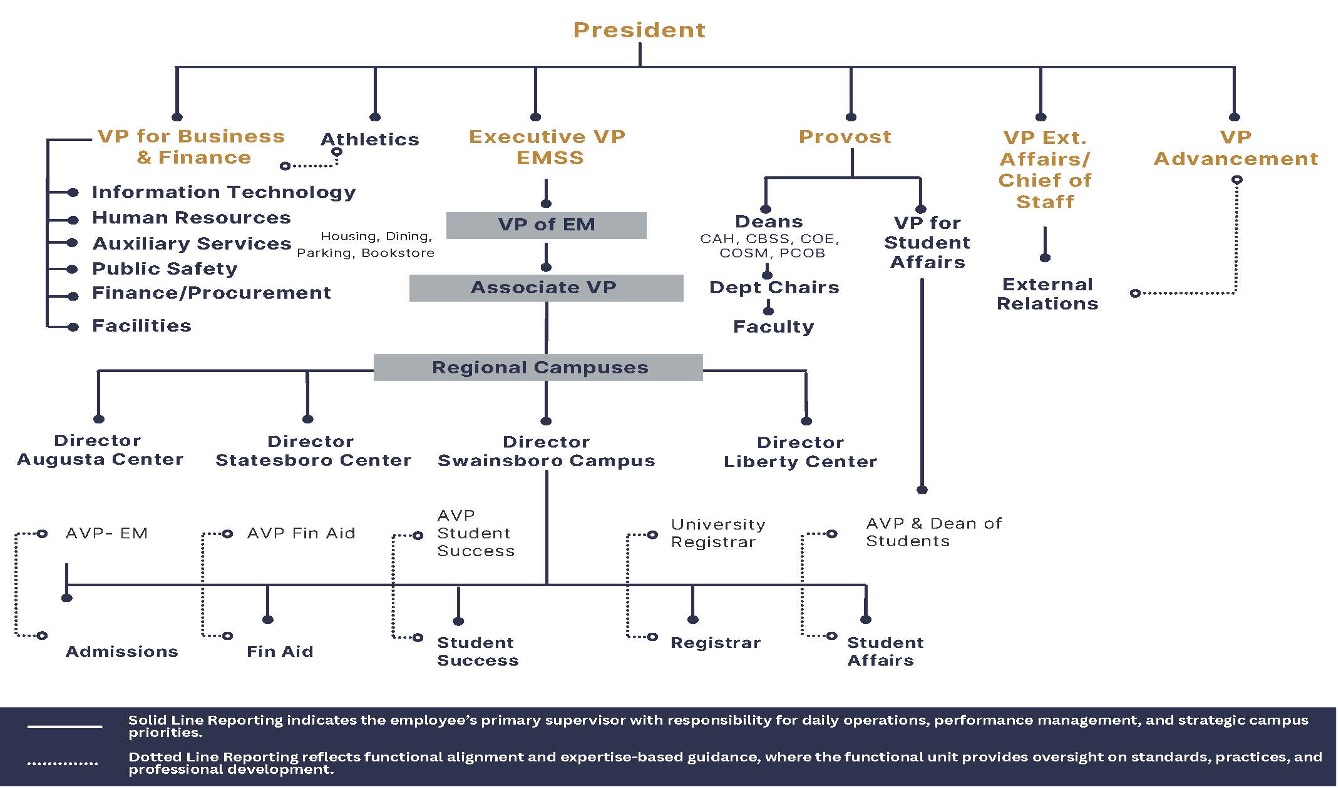
Presented below is the organization chart showing where East Georgia State College was placed within the operational structure of Georgia Southern University on July 1, 2025, the beginning of FY 2026. On this day, the following positions were established:

  • GS President became the Interim President of EGSC
  • GS Associate Provost for Institutional Assessment and Accreditation and Institutional Accreditation Liaison became EGSC’s Acting Provost and Chief Academic Officer
  • GS Associate Vice President for Enrollment & Student Success became the supervisor of a newly appointed Swainsboro Campus Director

Figure 1: GS/EGSC Pre-Consolidation Organization Char

Georgia Southern-East Georgia State College Organizational Chart

With the East Georgia/Georgia Southern consolidation scheduled to take effect on January 1, 2026, East Georgia will focus on providing its students an increasing wealth of academic and co-curricular resources that facilitate their persistence, progress and on-time completion of undergraduate degrees.

As one example, East Georgia students will benefit from the partnership between Georgia Southern and the National Institute for Student Success (NISS) at Georgia State University. According to NISS’s latest Report, one-year retention rates among Georgia Southern’s bachelor degree seeking students increased by 5.7 percentage points from 71.2 percent for Fall 2021 to 76.9 percent for Fall 2024. With its mission to be an open access point to the USG, East Georgia has long had a strategic priority to improve its retention rates, including fall-to-spring and spring-to-fall semesters, in addition to one-year fall-to-fall semesters. The consolidation with Georgia Southern will provide East Georgia students with a learning and growth environment that encourages them to stay through degree completion.