Skip to content Skip to navigation

Dalton State College Campus Plan Update 2025

The mission of Dalton State College is to serve as a catalyst for opportunity and success, dedicated to transforming lives and cultivating partnerships for our students and our region.

In pursuit of that goal, Dalton State offers targeted four-year and two-year degrees and career certificate programs, along with a wide variety of activities that engage students in local community businesses and industries. Each of the College’s four schools (the School of Arts and Sciences, the Wright School of Business, the School of Education, and the School of Health Professions) forges important partnerships to inspire students to be active members within their professions and communities.

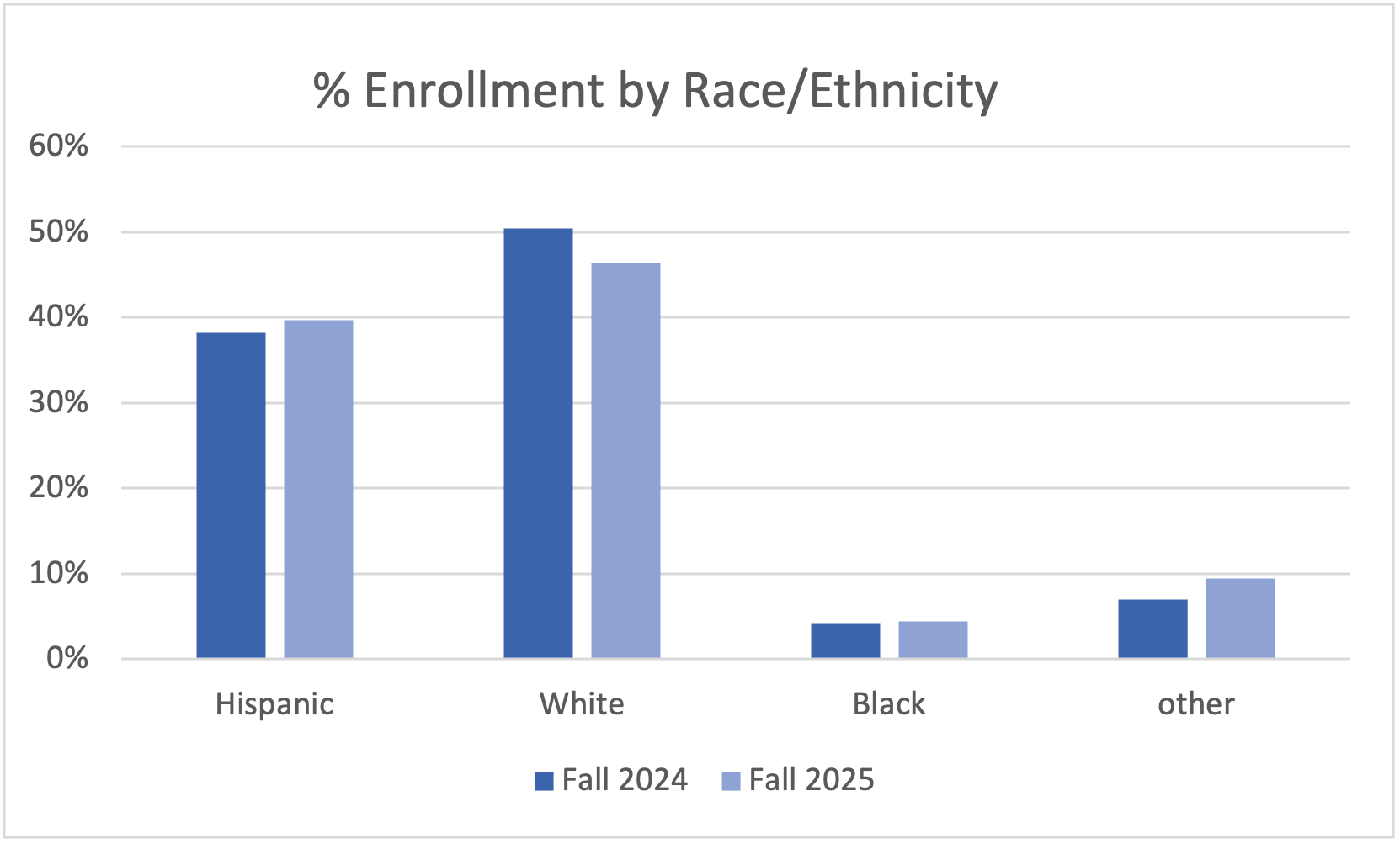
Dalton State is Georgia’s first Hispanic-Serving Institution (HSI). When Dalton State achieved HSI designation in 2018, Hispanic students comprised 29% (1,496) of the student population. That percentage has grown steadily since; by Fall 2025, Hispanic students made up 40% (2,209) of the student population. In terms of other ethnicities, the percentage of white students decreased from Fall 2024 to Fall 2025. In Fall 2024, white students comprised 50% (2,595) of the student population, whereas in Fall 2025, white students made up 46% (2,587). The African American student population maintained at 4% of the total. On the other hand, other races (multiracial, Asian, and undisclosed student populations) increased from Fall 2024 to Fall 2025.

Dalton State College Percent Enrollment by Race

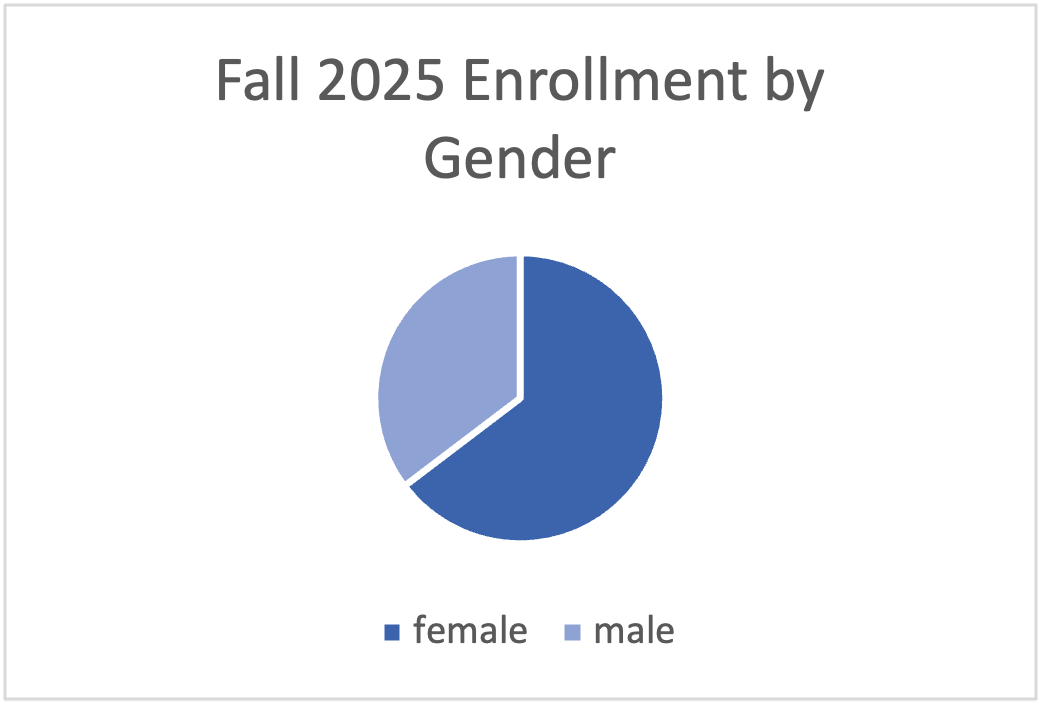
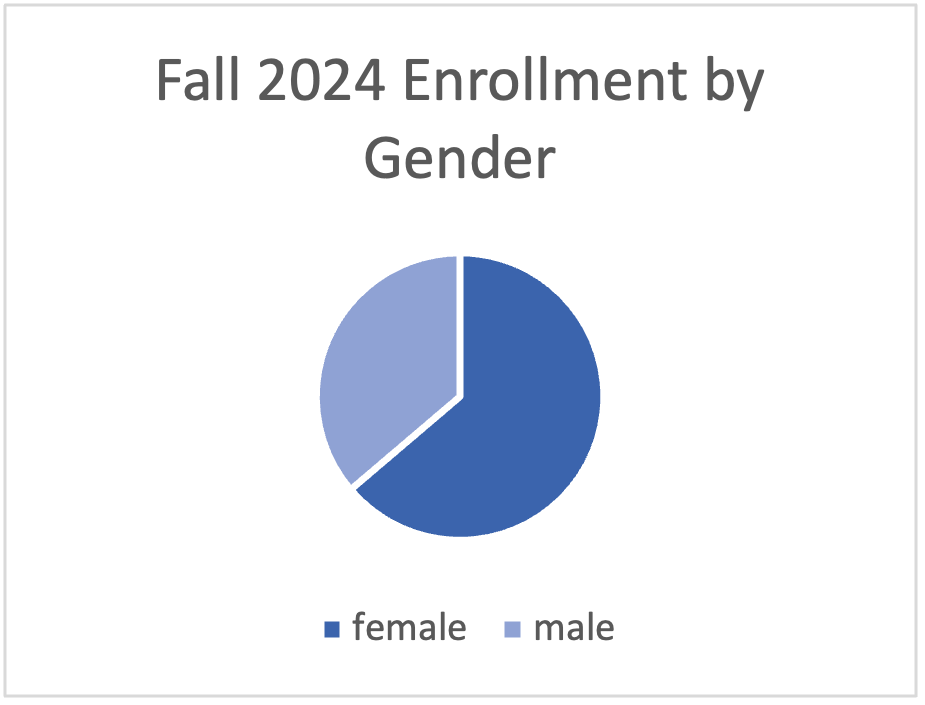
As of Fall 2025, Dalton State’s student body was 65% (3,602) female and 35% (1,968) male. This proportion is only a slight difference from Fall 2024.

Dalton State Fall Enrollment by Gender Dalton State Fall 2024 Enrollment by Gender

Dalton State students also tend to be between the ages of 18 and 24. The percentage of students aged 25 and older grew significantly (121%) from Fall 2024 (419 students) to Fall 2025 (928 students) with a majority studying in nursing pathways, organizational leadership, elementary education and various business programs. The student body has 95 student athletes across 6 sports. With one residential hall, 93% of Dalton State students commute to campus.

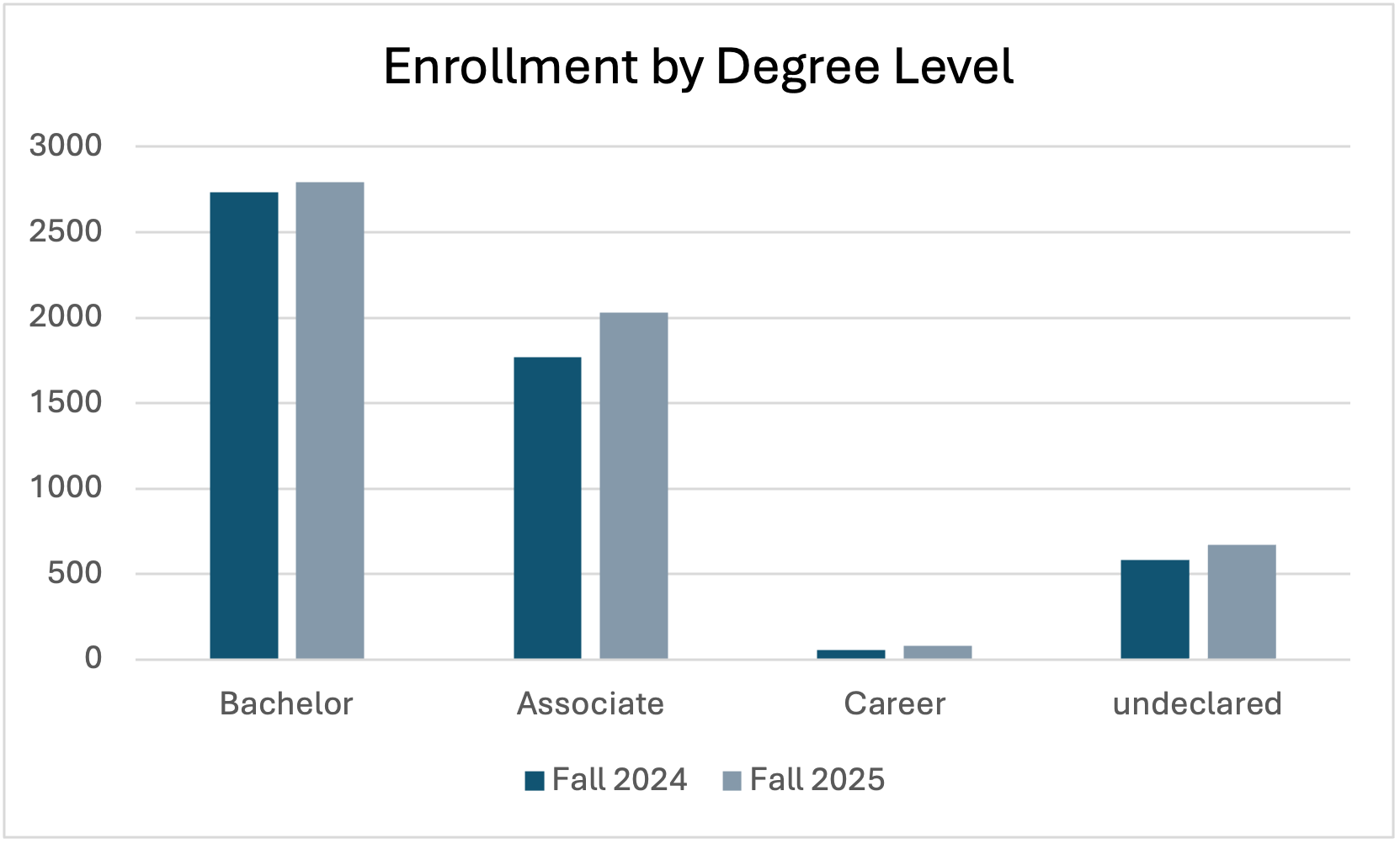
While overall enrollment has increased, the percentage of students seeking Bachelor’s Degrees continues to decline dropping from 53% (2,735) in Fall 2024 to 50% (2,792) in Fall 2025.  However, the percentage of Dalton State students seeking Associate’s Degrees has increased over the past several years—from 30% in Fall 2022 (1,382) to 36% (2,028) in Fall 2025. This increase reflects an effort to meet the demand for more health professions graduates. The percentage of undeclared students has also increased over the past four Fall semesters. In Fall 2022, the percentage was 6.0% (267) and by Fall 2025, it was 12% (671). This increase reflects intentional efforts in dual enrollment recruitment. Career certificate students saw little change, however, comprising 1% of the student population in last 4 Fall semesters.

>Dalton State Enrollment by Degree Level

Full time students represent 55% of the Fall 2025 student enrollment which is a slight decrease from 57% in Fall 2024.

Dalton State is currently in the process of updating our comparator and aspirant institutions. Below is our current list, which is used by the National Center for Education Statistics (NCES) to provide comparative data between institutions.

The fifteen institutions are:

  • College of Coastal Georgia (Brunswick, GA)
  • CUNY Medgar Evers College (Brooklyn, NY)
  • Georgia Gwinnett College (Lawrenceville, GA)
  • Gordon State College (Barnesville, GA)
  • Indiana University—Kokomo (Kokomo, IN)
  • Lewis-Clark State College (Lewiston, ID)
  • Missouri Southern State University (Joplin, MO)
  • Nevada State College (Henderson, NV)
  • Northwest Florida State College (Niceville, FL)
  • Pennsylvania College of Technology (Williamsport, PA)
  • Rogers State University (Claremore, OK)
  • SUNY College of Technology at Canton (Canton, NY)
  • University of Arkansas—Fort Smith (Fort Smith, AR)
  • Utah Tech University (St. George, UT)
  • West Virginia University at Parkersburg (Parkersburg, WV)

Success Inventory

PACE (Perspectives, Advising, Campus Resources, Engagement) program – Quality Enhancement Plan, 2023-2028 (Dalton State College-2025)

Strategy/Project Name: 
PACE (Perspectives, Advising, Campus Resources, Engagement) program – Quality Enhancement Plan, 2023-2028
Momentum Area: 
Change Management
Strategy/Project Description: 

PACE is a first-year student program that provides intentional interventions through both curricular and co-curricular activities that support academic perseverance and enhance a sense of belonging. Beginning with First Chime, a fun convocation to “ring” in the beginning of the school year, students are connected to faculty members in their focus area and peer mentors to understand expectations for the first weeks of school. Interventions are planned and implemented in Perspectives (our first-year seminar course). Advising and campus resources presentations are given followed with lab activities intended to integrate students into these critical areas of support. Understanding the importance of engagement, additional activities are weaved into the curriculum to encourage connection to campus. Through the Perspectives class, students are provided reflection opportunities to help synthesize their learning. The program is coordinated through the Student Success unit but involves faculty from all academic departments, Office of Student Transitions, Office of Student Engagement & Belonging, Peer Education and the Advising Center.

The Quality Enhancement Plan seeks continuous improvement relative to two Student Learning Outcomes:

1. Students will demonstrate knowledge and skills that develop their academic perseverance.

2. Students will describe an enhanced sense of belonging within the College.

Activity Status: 
Evaluation/Assessment plan: 

PACE leadership coordinates and collects data at various points of the year, including a biannual report of plan project areas, annual administration of NSSE, and course reflections rated with the AAC&U Lifelong Learning VALUE rubric. The PACE Ambassadors and a group of volunteer faculty and staff assessed the associated artifacts, which were reflections on in-class presentations on advising, campus resources, and engagement. Each artifact was double scored to ensure inter-rater reliability. In lieu of suggested best practices of a 20% randomized sampling, a randomized sampling of 15% was assessed, due to the bandwidth of evaluators and the volume of the artifacts.

KPIs, Measures, Targets, Results, Goals

  1. Associated Competencies with PRSP course—Increase understanding of someone else’s views by imagining how an issue looks from their perspective. Measure: NSSE question 2e: Tried to better understand someone else’s views by imagining how an issue looks from his or her perspective.
    Targets: 2023 – 65% chose “often” or “very often,” 2024 – 68%, 2025 – 71%, 2026 – 74%, 2027 – 76%
    Results: 2023 – 72% chose “often” or “very often,” 2024 – 71%, 2025 –79% Assessment: NSSE results indicate that Dalton State exceeded its target not only for 2025 but also for the life of the QEP.
  2. 2.  Design interactions for students to understand available engagement opportunities.
    Measure: NSSE 14e: Felt the institution placed emphasis on providing opportunities to be involved socially.
    Targets: % students choosing “often or “very often.” 58% baseline established in 2020. Targets include: 60% (2024); 63% (2025); 66% (2026); 68% (2027) Results: In 2025 80% chose “often” or “very often.”
    Assessment: NSSE results indicate that Dalton State vastly exceeded the target on this measure. Additionally, the Modern Campus App, DSConnect is at the point of full implementation. Although not reflected in this data cycle, “Fledge Fest,” our half-day event for first-year students was in and of itself an engagement opportunity and included an engagement fair. Consequently, we anticipate that this event will positively affect NSSE data for 2026.
  3. Develop common PRSP activities (engagement with reflections)
    Measure: Foundations and Skills for Lifelong Learning Rubric (AAC&U) scoring for PRSP course reflections
    Targets: 51 presentations (baseline established year 1), rubric mean 1.61/4 (baseline established year 2)
    Results: Advising and Campus resource reflections for Fall 2025 will be scored at the end of the semester. Engagement reflections will be assessed later this semester through a different program, called “Fledge Fest.”
    Assessment: Efficacy of Fledge Fest was assessed through a student survey. However, the results of the survey are not available as of this writing.
  4. Expand outreach from Student Success and Advising Center.
    Measure: Budget positions in the Student Success and Advising Center. Targets: 1 new budged position, move 2 grant-funded positions to budgeted positions, 1 part-time adviser
    Results: Student success and advising met these targets in a previous reporting cycle and are maintaining work with recent growth.
    Assessment: Interventions are implemented.
  5. Create campus traditions for first-year students
    Measure: Plan and implement First Chime, our new student convocation. Targets: 78% of incoming first-year students attend First Chime.
    Results: For Fall 2025 1,751 new freshmen students were admitted and 1,426 attended First Chime (81%), exceeding our 78% goal.
  6. Expand outreach from student resources across campus.
    Measure: NSSE 14c: How much the institution emphasized using learning support services.
    Targets: % choosing “very much” or “quite a bit.” 63% baseline established in 2020. Targets include: 66% (2023); 69% (2024); 72% (2025); 75% (2026); 80% (2027).
    Results: 2023: 78%; 2024: 80%, 2025: 83% Assessment: NSSE results indicate that Dalton State vastly exceeded the target for this measure for the life of the QEP.
Progress and Adjustments: 

This year, findings from the AAC&U Lifelong Learning VALUE Rubric of the advising and campus resources presentations were statistically significant. However, there was still a low response rate of students who completed the reflection. One intervention to improve response rates is that Perspectives faculty discussed administering these reflections in class. The previous section on assessment points to student interventions being highly effective. First Chime’s second annual iteration had some logistical adjustments but was highly successful. Also, as previously mentioned, we piloted Fledge Fest. Consequently, a framework for student transitions to college is becoming more solidified on our campus.

Plan for the Year Ahead: 

PACE program is associated with our QEP and has two more years in its duration. We are currently transitioning the program’s director which we do not anticipate being disruptive. As we complete the Fall 2025 semester, we will assess student reflection’s and avenues for Perspectives class faculty to provide feedback for improvements in the next year.

Challenges and Support: 

Maintaining momentum of the program as we continue to make improvements each year will be the biggest challenge. Faculty engagement in the program is critical to its success in the classroom so particular efforts will be made to ensure the program’s value and impact on student success.

Primary Contact: 
Forrest Blackbourn, QEP Director
Brooklyn Herrera, incoming QEP Director

Common Course Components in GeorgiaVIEW (D2L) (Dalton State College-2025)

Strategy/Project Name: 
Common Course Components in GeorgiaVIEW (D2L)
Momentum Area: 
Change Management
Strategy/Project Description: 

Having researched the ways in which faculty employ GeorgiaVIEW and students view their experience using it in their face-to-face, hybrid, and online classes, we plan to work toward improving the GeorgiaVIEW experience for faculty and students through more consistent usage of the LMS. Additionally, we will continue to research the possibility of incorporating a common course experience (i.e., course templates or shells to streamline the instructional design).

Activity Status: 
Evaluation/Assessment plan: 

The group previously said the evaluation/assessment will be contingent on following through with the plan for the year ahead by doing some interventions with faculty and in turn studying whether that has affected the student experience.

Progress and Adjustments: 

At this stage, the working group has not been able to implement its proposed plans (listed below). While the CETL director did offer sessions on GeorgiaVIEW during the opening week activities, other priorities overshadowed this effort. Several members of the working group shifted efforts to work on the syllabus posting initiative. Plus, each member of the working group has limited time to devote to this task due to campus responsibilities that extend beyond their normal classroom teaching.

Plan for the Year Ahead: 
  1. Developing Best Practices List/Faculty Workshop.
  2. Working to include GeorgiaVIEW in all PRSP courses.
  3. Revising and redelivering the survey.
Challenges and Support: 

As noted above, the greatest challenge is time to work on the project. None of the people initially involved truly have time at present to add something else to their responsibilities. What we are really seeing is that absent additional staffing for instructional design support to work in conjunction with CETL this initiative will be difficult to implement in a meaningful way. CETL will continue to provide training on GeorgiaVIEW and the GeorgiaVIEW administrator is working on additional videos to help introduce faculty to features they might not be aware of.

Contact email: 
Primary Contact: 
Sarah Mergel, Chair, Department of Social Sciences and History

Support of ELL students in ENGL 1101 (Dalton State College-2025)

Strategy/Project Name: 
Support of ELL students in ENGL 1101
Momentum Area: 
Purpose
Strategy/Project Description: 

The original plan read, “Research situation for English language learners (ELLs) in ENGL 1101 through the administration of surveys to students. From this research, we may create a project to provide additional ELL support to ENGL 1101 faculty and/or students.”

In late Fall 2024, a survey went to all ENGL 1101 and 1102 students. Two-hundred and sixty-three students answered the following questions:

  1. Which class are you taking this semester?
  2. For which topics do you feel like you could use help?
  3. Have you ever used one-on-one tutoring through Peer Education?
  4. Have you ever used the Writing Lab?
  5. What tools have you used to help you edit your essays?
  6. What resources would you like the campus to offer?

Students responded that they need help with organization, critical thinking, MLA formatting and documentation, grammar and mechanics, and practice with the English language.

Ten students noted that they would like practice with the English language. The number of students faculty report as struggling with language in their classes vary from 40-60 students per semester. However, only a small number of students—as noted here—acknowledge the need for help. One-hundred and ninety-four students stated that they use Grammarly to help them write essays, and twenty students stated that they use ChatGPT/AI. Eighty students stated they used the Writing Lab. Sixteen students said they used tutoring from Peer Education.

Activity Status: 
Evaluation/Assessment plan: 

Due to an imminent change with the organizational structure of the Writing Lab on campus, this project needs to be discussed with members of Academic Affairs, Peer Education, and the Department of English.

Progress and Adjustments: 

A bilingual, part-time Writing Lab tutor was hired over the summer to assist students needing help with English as a language. Dr. Brian Hibbs, Professor of Education, volunteered in the Writing Lab in Fall 2025. Dr. Hibbs has taught Spanish courses and teaches Methods of Teaching ESOL and Applied Linguistics for Teachers of ESOL. He and I discussed Education students working on TESOL projects working with students in 1101 when possible.

Last academic year, Dr. Hibbs provided a training session for faculty on strategies for helping ELL students in the classroom.

Professors have been referring struggling students to Ms. Nancy Avila de Welles, our bilingual DSC’s Non-Clinical Case Manager/Social Worker. She provides students with campus and community resources.

Plan for the Year Ahead: 

To be determined since the Writing Lab is transitioning its oversight to another department.

A new plan within the Department of English will need to be discussed with the transition of the Writing Lab, and the project coordinated with other areas.

Challenges and Support: 

Helping students write essays when they are not proficient in the English language.

On the survey, students indicated a high use of Grammarly and ChatGPT, which means that they are clicking buttons to write their essays and not gaining language skills (or any other skills). The campus does not provide language courses, so students who need help with language skills must find community resources. Dr. Brian Hibbs does provide a community English class and is thus a resource.

Contact email: 
Primary Contact: 
. Kerri Allen, Chair, Department of English

Roadrunner Scholars Summer Bridge Program (Dalton State College-2025)

Strategy/Project Name: 
Roadrunner Scholars Summer Bridge Program
Momentum Area: 
Mindset
Strategy/Project Description: 

The Roadrunner Scholars is a residential and immersive summer bridge program designed for students requiring learning support math and English.  In this six-week program, students were enrolled in both learning support math and English as well as their credit course counterparts, and the Perspectives seminar. Roadrunner Scholars were provided tutoring assistance, peer education, development opportunities, as well as social activities.  All aspects of the program were provided at no cost to the student through scholarships offered by our Dalton State Foundation.  Students were invited to apply for the program based on their high school GPA and requirement of learning support classes. The program ended with a Celebration dinner.

Activity Status: 
Evaluation/Assessment plan: 

In addition to the completion rates, the students were surveyed at the end of each course (math and English).   Below are some of the results for summer 2025.

  • For math, 19/25 (76%) successfully passed MATH 1101.
  • For English, 24/25 (96%) successfully passed ENGL 1101.
  • For the seminar course, 20/24 (83%) successfully completed PRSP 1010.

Five participants earned a 4.0 GPA, and all 25 enrolled in Fall 205 classes.

Participants were surveyed about their experience.  

100% of the survey respondents (7) stated that they would recommend the program to other incoming students.

100% felt somewhat or extremely confident about starting college after the program 

When asked, “Do you feel that you've built any meaningful relationships (e.g. with your instructors, classmates, staff, etc.) as a result of participating in this program?” students responded with:  

  • Yes, at first, I believed that I would not make any friends, but I made plenty of friends in this program, and I also thought the professors would be hard on us, but all the professors were very understanding and taught very well.
  • yes! I thought i was going to be alone for the whole program the first day, but at the end i knew and could talk to anyone without trouble!
  • Me and my roommate are still very good friends so yes.
  • Yeah, some professors helped me through my work and made the learning experience really good.

 These data will be collected with each cohort.

Progress and Adjustments: 

The program is completed for 2025.  Faculty and staff participants are sharing feedback as we look on ways to improve for 2026. Main discussion focuses on the 11-credit hour load and inability for students to attend more co-curricular activities due to the homework necessary for the intensive pace.

We have had a commitment of up to $110,000 funding from the Dalton State Foundation for this initiative.

Plan for the Year Ahead: 

We will begin to send invitations to apply in January 2026 using our CRM. Follow-up will occur with those submitting applications to try to increase participation.

The program will begin again in June 2026.

Challenges and Support: 

One potential challenge may be funding.  Our Dalton State Foundation has pledged $110,000 to support.  However, should additional funds be needed to support the expanded program, then we will need to identify a source. 

Scaling the program has been difficult in recruiting more students to make the full summer commitment.

Primary Contact: 
Elizabeth Hutchins, Assistant Provost/AVP for Student Success

Supplemental Updates

Supplemental Updates

As part of our ASPIRE Top Five Strategies, Northwest Georgia Connect is a project working to create pathways for Georgia Northwestern Technical College (GNTC) and Chattahoochee Technical College graduates to receive degrees at Dalton State College (DSC) and Georgia Highlands College (GHC) using courses completed at GNTC. These pathways indicate the degrees students can earn and the courses they will complete at GNTC to obtain those degrees. They also show to which DSC or GHC programs the students can transfer their GNTC courses. These pathways will be shared with students at GNTC, DSC, and GHC, as well as prospective students of those institutions. Pathways in Phase 1 were signed in December 2024. Business programs are part of Phase 2 which is underway. Dalton State has also renewed work on articulation agreements with Chattanooga State Community College in Tennessee.

Two other ASPIRE Top Five Strategies for Dalton State that also align with Dalton State’s Vision 2050 strategic plan included creating a Roadrunner Experience and working on course differentiation to increase the number of students engaging in experiential learning.

The Roadrunner Experience Committee’s charge to enhance student success, start building a cohesive “Core” experience for all Dalton State students, and to start engaging with civil dialogue and debate grounded in moral and ethical reasoning – Dalton State initiated its first “Fledge Fest” designed to strengthen the first-year experience at Dalton State. Held mid-way through the fall semester, Fledge Fest provides a strategic touchpoint to reconnect first-year students as a cohort after their initial transition to college life. The event encourages students to reaffirm their affinity for Dalton State, reflect on their values, engage in meaningful dialogue and exchange, and deepen their sense of community. Through interactive sessions, motivational programming, and opportunities to engage with faculty, staff, and peers, students gain a renewed understanding of what it means to be a Roadrunner. In 2025, Fledge Fest welcomed 876 of the 1,242 invited first-year students, representing an impressive 70.5% participation rate. Students were inspired by keynote speaker Jarryd Wallace, a Paralympian who shared his story of resilience and purpose. A faculty and staff panel followed, exploring the importance of civil discourse and modeling how to engage in meaningful dialogue across differing perspectives.

Additionally, seven staff facilitators led breakout sessions designed to help students reflect on their values and understand their role in decision-making and community engagement. The event concluded with an Engagement Fair, allowing students to explore involvement opportunities and connect with campus resources. The program was further enriched by the participation of Perspectives faculty, many of whom attended with their classes to reinforce the importance of connection, reflection, and community within the first-year experience.

Coordinated through our Center for Teaching and Learning, Dalton State received a USG mini grant to develop and refine a scalable, structure protocol for reviewing and evaluating High-Impact Practices. Also, at work are experiential learning efforts coordinated through a Title III STEM grant to increase the students participating in undergraduate research, imbed research opportunities in core STEM classes and connect STEM students to internship opportunities. Along with further development of the Roadrunner Experience, Dalton State plans to provide intentional avenues for all students to be involved in experiential learning during their academic journey.

Observations and Next Steps

As evidenced in our Student Success Inventory and our Optional Supplemental Updates, Dalton State has a strong focus on student success, and this success has manifested itself in improved enrollment, retention and graduation rates.  Over the last three years, Dalton State has had a 22% increase in enrollment. After experiencing a 10-point increase in our retention rate from Fall 2022 to Fall 2023 cohorts, the Fall 2024 FTFT cohort’s one-year retention rate increased another 1.4-point ranking Dalton State as a leader among the state college sector. Our institution-specific 6-year baccalaureate graduation rate for the Fall 2019 FTFT baccalaureate-seeking cohort improved by 3 points to 26.8%. Dalton State College has earned recognition in three categories of U.S. News & World Report’s 2026 Best Colleges rankings, standing out as No. 1 in Georgia and No. 11 overall on the Top Public Schools in the South list. Dalton State was also recognized as a Top 20 Best Hispanic-Serving College.

Among our successful retention efforts has been our Quality Enhancement Plan (QEP), known as PACE (Perspectives, Advising, Campus Resources, and Engagement). Dalton State ensures that all students in the first-year course, Perspectives (PRSP), participate in similar interventions, including advising and campus resources. For example, all PRSP courses include a common presentation and lab component related to these student success areas. PRSP students also engage in rich collegiate experiences, such as Dalton State’s New Student Convocation, called “First Chime.” The day before classes started in August 2025, First Chime welcomed over 1,400 new first-year, transfer, and dual enrollment students to campus. Students met with their PRSP faculty and classmates, enjoyed games, live music, food trucks, and a merchandise tent. The evening culminated with the lighting of the James A. Burran Bell Tower and a fireworks display. Dalton State is proud of its First Chime event, which is quickly becoming a Roadrunner Tradition.

Dalton State earned the Seal of Excelencia through work with the organization Excelencia in Education to develop practices that will better serve all students. The Seal of Excelencia is a national certification for institutions that strive to go beyond enrollment to intentionally SERVE Latino students. The framework used focuses on data, leadership, and practice in support of developing a comprehensive institutional strategy. In 2023, the Dalton State team completed the virtual Evidence-Based Practice Institute and completed a research project evaluating the effectiveness of interventions and support offered through our CARE (Campus Assessment, Response, and Evaluation) Team and social worker. In 2024, our team attended the Excelencia Data Institute, and Dalton State is now part of the 2025 cohort Modeling Intentionally Serving Hispanic Serving Institutions. The current year has focused on policy development, and the upcoming year will center on financial models.

Dalton State has also engaged the services of the National Institute of Student Success (NISS) at Georgia State University. Work with NISS diagnostic team began in April 2025. Dalton State is expecting their diagnostic review and playbook later in November. Once this process is complete, Dalton State will evaluate the data-driven recommendations and being implementation.

Other future work will involve solidifying our articulation agreements with Georgia Northwestern Technical College (GNTC), Chattahoochee Technical College, and Georgia Highlands College (GHC) detailed in Section 3 above. Additionally, we will further define and develop the Roadrunner Experience, also addressed in Section 3. While originally focused on the value of IMPACTS courses, the Roadrunner Experience vision has evolved to include creating common academic and developmental experiences for students throughout their college careers. Within this more encompassing experience will be a variety of opportunities and activities, including experiential learning options for all students. Increasing experiential learning for Dalton State students had originally been a separate initiative within Dalton State’s Top Five Strategies for ASPIRE, but the goal now is to incorporate it into a larger Roadrunner Experience. Student Success efforts will continue to align with Dalton State’s Vision 2050 strategic plan: Transforming lives and partnering for success.