Reimagining First Year Composition and Math
Success in first-year courses has a dramatic, direct effect on retention and graduation. At the core of the USG general education curriculum is English Composition and Mathematics. Given the importance of transferability between institutions, their purpose and outcomes as well as their place within the general education curriculum is set at a system level. Yet, these courses have not been significantly revised at the system level since 2004.
A Changing Landscape
- Generative AI Integration: Undergraduate utilization of AI tools has escalated dramatically, jumping from 66% in 2024 to 95% in 2026. This structural shift transforms how students approach assignments and demands a modern pedagogical framework that preserves critical thinking.
- National Reading and Comprehension Decline: According to the 2024 NAEP Report Card, average 12th-grade reading scores dropped by 3 points compared to 2019, and sit 10 points lower than the baseline in 1992. Students enter higher education with vastly different preparation profiles.
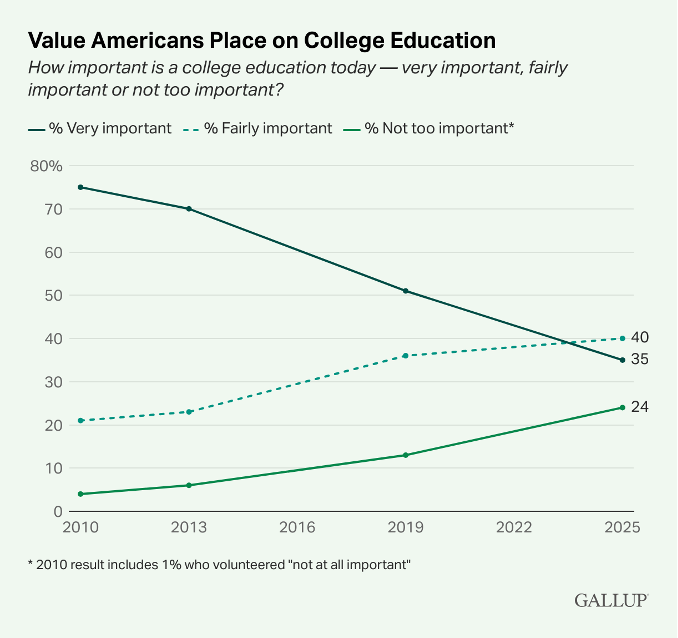
Source: https://news.gallup.com/poll/695003/perceived-importance-college-hits-ne...
- Discourse on Higher Education's Value: Public confidence and perceived importance of a college education have declined across all demographic subgroups, with only about one-third of Americans currently describing a college degree as "worth the cost." Clear structural alignment with essential career competencies is required.
- Workforce Competency Gaps: While 96% of employers rate critical thinking and communication as extremely important, a substantial gap exists between employer expectations and perceived student readiness upon entering the workforce.
The curriculum needs to adapt to these societal changes. It is time to shift our focus to what students need to succeed, we aren't just changing curriculum—we are changing life trajectories.
USG Success Rates
The USG fall 2025 pass rate for first-time freshmen in ENGL 1101 was 78%, a 7 percentage point increase since the launch of generative AI in 2022. In math, despite more than a decade of efforts promoting math pathways, MATH 1111 College Algebra continues to be the most popular math course (even if we exclude dual enrollment) where the fall 2025 pass rate was 68%. College Algebra is designed to prepare students for Precalculus and Calculus, yet only 15% of College Algebra students went on to take Calculus.
On average, 50% of USG first-time freshmen who enroll but do not pass ENGL 1101 or MATH 1111 courses are not retained – so the first attempt is our only chance at impacting these students.
In addition to this critical student impact, this also has significant impact for our institutions: With the national population of high school graduates having already peaked in spring 2025 and a projection of steady declines through 2041, shifting our focus toward keeping the students we already have is of critical importance to institutional health.
Strategic Action Paths
Core Objective: This is a pivotal moment to reimagine the first-year experience in math and writing around the knowledge, skills, and abilities students truly need for their futures. This project is an invitation to explore what higher education institutions should be teaching today and in the future, rooted in local, system, and national data.
It is time to move past incremental adjustments and look toward structural redesign. This includes evaluating the explicit purpose of English Composition and Mathematics from the perspective of the student, academic programs, and both internal and external stakeholders. This monumental effort requires deep, collaborative work between USG system office staff and the administration and faculty at each of our individual institutions.
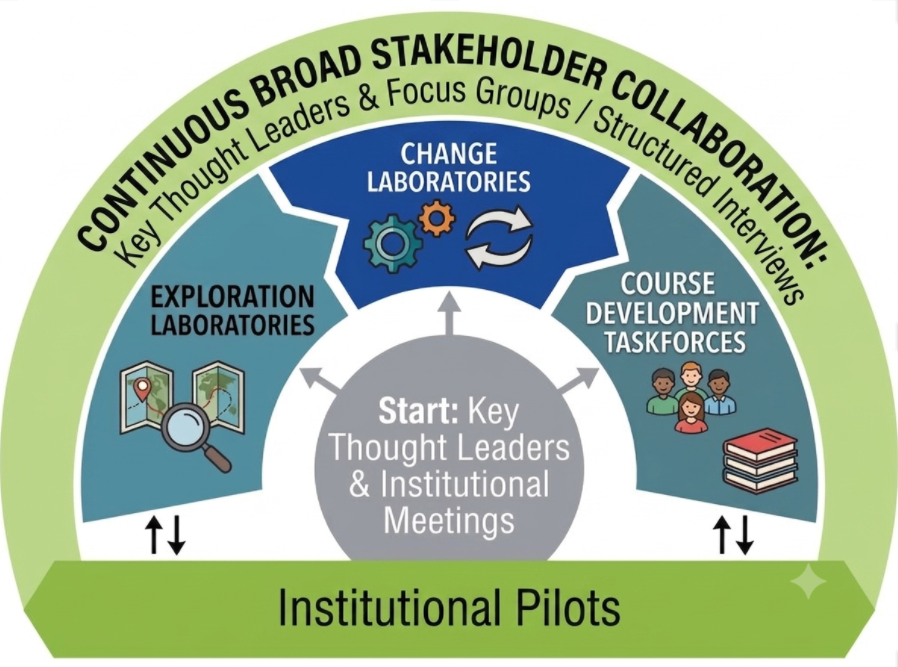
Conversations began with the 2026 Momentum Summit, Georgia Organization for Student Success (GOSS) annual meeting, and the North and South Regional Corequisite Academies, followed closely by meetings with the General Education Council, the English and Math CAGs, and USG Provosts.
This next year will focus on redefining the purpose for English Composition and Mathematics for the students of tomorrow and having faculty experts develop broad recommendations for how we might reshape these courses. We’ll do this work through discussions at each institution, change laboratories (convening faculty and staff experts in these areas), and focus groups targeting all stakeholders involved with this work (faculty, staff, students, industry, K-12 education, and the community). We’ll also invite institutions to pilot innovative practices in these courses that will help inform the broader system level work. Once the recommendations for change are in-hand, task forces will do the work of modernizing the English Composition and Mathematics curriculum for approval by the English and Math CAGs, the Council on General Education and our institutions.
ReImagining Team
Contact Us
Aimee Berger
aimee.berger@usg.edu
Duane Day
duane.day@usg.edu
Jonathan Watts Hull
jonathan.hull@usg.edu
Melanie Largin
melanie.largin@usg.edu
Laura Lynch
laura.lynch@usg.edu
Jennifer Palmer
jennifer.palmer@usg.edu